
Following a cricket match involves more than checking the final score. Team form, player performances, match conditions, venue history, and recent statistics can all provide useful context.
Reddy Anna match analysis can be approached as a structured research process. Instead of relying on a single statistic or recent result, readers can compare several important factors before forming their own understanding of a fixture.
This guide explains how to analyze a cricket match step by step and what information is worth checking before the game begins.
What Is Cricket Match Analysis?
Cricket match analysis is the process of studying available information about two teams and their upcoming fixture.
The analysis can include:
- Recent team results
- Player performance
- Batting statistics
- Bowling statistics
- Venue conditions
- Match format
- Weather
- Playing XI information
- Head-to-head records
- Recent team news
The importance of each factor can change depending on the match format.
For example, statistics that are useful in Test cricket may not have the same importance in a short T20 match.
Why Team Form Matters
Recent team form provides useful context when researching a match.
Instead of looking at only the last result, consider several recent fixtures. Check whether the team has been consistently performing well or experiencing mixed results.
Useful information can include:
- Recent wins and losses
- Runs scored
- Wickets taken
- Chasing performance
- Defending performance
- Performance against similar opponents
However, recent form should not be treated as a guarantee of the next result.
A team can perform differently from one match to another because of players, conditions, opposition, or other circumstances.
How to Analyze Batting Performance
Batting statistics can help explain how a team has performed with the bat.
Depending on the format, useful numbers may include:
- Runs scored
- Batting average
- Strike rate
- Boundaries
- Runs per innings
- Top-order contributions
- Middle-order performance
In T20 cricket, strike rate can be particularly useful because teams have a limited number of deliveries.
In longer formats, batting average and consistency may provide more useful context.
The key is to compare statistics within the same format whenever possible.
Understanding Bowling Statistics
Bowling performance is another important part of match analysis.
Readers can look at:
- Wickets
- Economy rate
- Bowling average
- Strike rate
- Dot balls
- Powerplay performance
- Death-over performance
Different bowlers may have different roles within a team.
A fast bowler may be particularly important with the new ball, while another player may specialize in the middle or final overs.
Understanding these roles provides more context than looking only at the total number of wickets.
Player Form and Recent Performances
Individual player form can also influence the overall picture of a match.
Check recent performances rather than relying on a player’s reputation alone.
For batsmen, look at recent scores, consistency, and strike rate.
For bowlers, consider wickets, economy, and the situations in which they have performed well.
A player’s recent record should still be considered alongside the opposition and match conditions.
Why the Match Format Matters
The format changes how statistics should be interpreted.
Test Cricket
Test matches can continue for several days. Batting patience, bowling spells, pitch changes, and long-term consistency can become important factors.
One Day Cricket
One Day matches provide each side with a limited number of overs. Teams need to manage scoring, wickets, and bowling resources throughout the innings.
T20 Cricket
T20 matches have a much shorter timeframe. Powerplay scoring, strike rate, boundary hitting, death-over bowling, and quick changes in momentum can become especially important.
Because the formats are different, avoid directly comparing statistics from unrelated formats.
Venue Conditions and Pitch Information
The venue can provide additional context when analyzing a match.
Different grounds can have different characteristics. Pitch behavior, boundary dimensions, weather, and local conditions may influence how a match develops.
When researching a venue, consider:
- Recent scores
- Average first-innings score
- Chasing records
- Pace versus spin performance
- Boundary dimensions
- Recent matches at the ground
Venue statistics should be treated as historical information rather than a prediction of the next match.
Weather and Match Conditions
Weather can affect outdoor cricket in several ways.
Rain may delay a match, reduce the number of overs, or interrupt play.
Humidity, temperature, and wind can also influence playing conditions.
Before a match, check a current weather source and official match updates.
Weather information can change quickly, so an old forecast should not be treated as current information.
Head-to-Head Records
Head-to-head statistics show how teams have performed against one another historically.
They can include:
- Total matches
- Wins by each team
- Recent meetings
- Performance at a particular venue
- Results within a specific format
However, older matches may have limited relevance if team squads and playing conditions have changed significantly.
Recent head-to-head results are generally more useful for current context than very old fixtures.
Playing XI and Team News
The announced playing XI can significantly change the context of a match.
Before analyzing a fixture, check whether key players are:
- Available
- Injured
- Rested
- Suspended
- Returning to the team
- Included in the playing XI
A team’s expected lineup and confirmed lineup are not always the same.
For this reason, check official announcements before relying on lineup information.
How to Build a Simple Match Analysis
A simple analysis process can be divided into five steps.
Step 1: Check the Match Details
Start with:
- Teams
- Competition
- Date
- Time
- Venue
- Format
Step 2: Review Recent Form
Look at several recent matches from both teams.
Step 3: Compare Key Players
Review important batting and bowling performances.
Step 4: Study Conditions
Check venue information and current weather conditions.
Step 5: Check the Playing XI
Use confirmed team information whenever it becomes available.
This process creates a more complete picture than relying on one statistic.
Common Mistakes in Cricket Analysis
Looking at Only One Match
One match can produce an unusual result. Several recent fixtures provide better context.
Mixing Different Formats
A player’s Test statistics should not automatically be used to judge their T20 performance.
Ignoring the Venue
Conditions can vary significantly between grounds.
Using Outdated Team News
Squads and playing XIs can change quickly.
Treating Analysis as a Guarantee
Statistics provide information, not certainty.
A well-researched analysis can still be wrong because cricket contains many unpredictable factors.
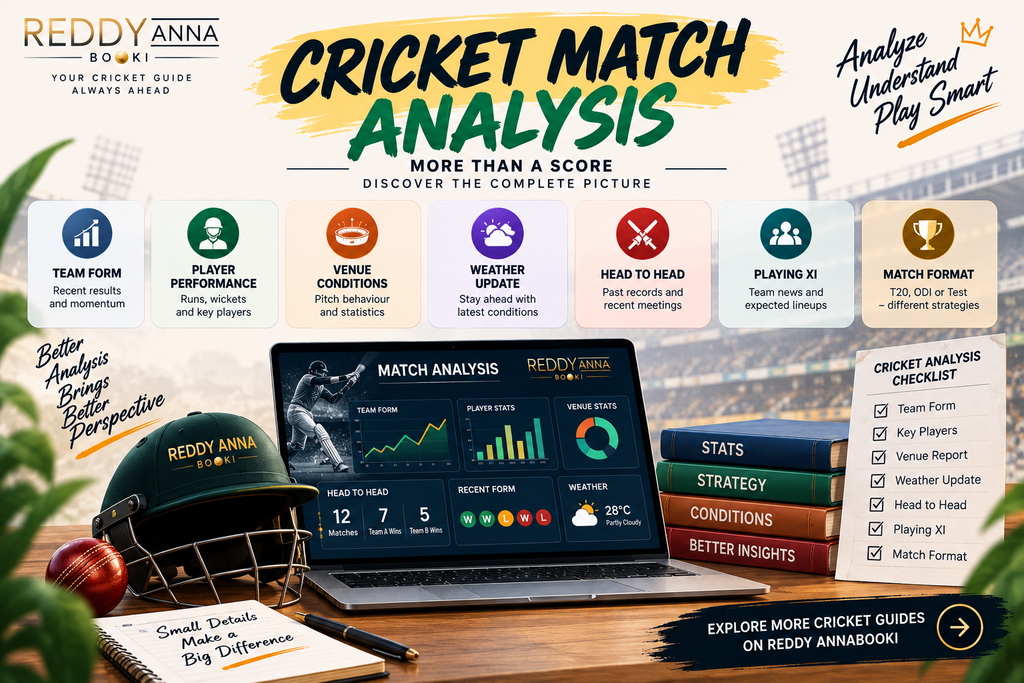
Reddy Anna Match Analysis Checklist
Before researching a match, use this simple checklist:
- Check the competition.
- Confirm the match format.
- Verify the date and time.
- Check the venue.
- Review recent team results.
- Compare batting statistics.
- Compare bowling statistics.
- Review important player performances.
- Check current team news.
- Confirm the playing XI when available.
- Check weather conditions.
- Separate facts from predictions.
This approach can make cricket research more organized and easier to understand.
Frequently Asked Questions
What is Reddy Anna match analysis?
Reddy Anna match analysis refers to researching cricket fixtures by comparing team form, player statistics, venue conditions, match format, and other relevant information.
Which statistics are useful for cricket analysis?
Useful statistics can include runs, batting average, strike rate, wickets, economy rate, recent form, and team records.
Does venue affect cricket matches?
Venue conditions can influence how a match develops. Pitch characteristics, boundaries, weather, and local conditions may all provide useful context.
Should I compare Test and T20 statistics?
It is better to compare statistics within the same format because Test, ODI, and T20 cricket have different rules and match structures.
Are previous results enough to predict a match?
No. Previous results provide historical context but cannot guarantee a future result.
When should I check the playing XI?
The confirmed playing XI is usually more useful than an early predicted lineup. Check official team announcements when available.
Final Thoughts
Good cricket analysis requires more than looking at a team’s latest result. Reddy Anna match analysis can be approached by combining team form, player statistics, venue information, weather, match format, and confirmed team news.
The most useful approach is to compare several pieces of information rather than relying on a single number or prediction.
Cricket remains unpredictable, so analysis should be viewed as research and context rather than a guarantee of any particular outcome.
For current fixtures, always verify important details with reliable and up-to-date sources before making decisions based on match information.